
Technical Notes on Imposition Operations (Pre-Press Considerations)
Imposition is the process of arranging individual pages or labels onto a single printing plate. The primary objective is to optimize the layout for post-press processes, especially for bound publications, ensuring that pages appear in the correct sequence after printing, folding, and trimming.The following key factors must be confirmed before proceeding to the plate-making stage:
1. Key Pre-Press Checkpoints
- Nature of the Job: Determine if it is a single-sided or double-sided print, and whether it consists of loose sheets, flyers, or multi-page signatures.
- Binding Method: This is the most critical factor for imposition layout.
- Saddle Stitching: Pages are nested and stapled through the fold.
- Perfect Binding: Signatures are stacked and glued at the spine.
- Thread Sewing: Sections are sewn together (common for high-quality books).
- Hardcover: Requires extra margins for the wrap and casing.
- Page Orientation:
- Portrait: Height is greater than width.
- Landscape: Width is greater than height.
- Signatures: A large sheet folded into the final trim size is called a signature. Imposition must account for the folding sequence and "creep" (inner pages shifting outward).
2. Common Printing Methods (Imposition Styles)
① Single-SidedOnly one side of the sheet is printed. Typically used for posters, packaging, or labels.
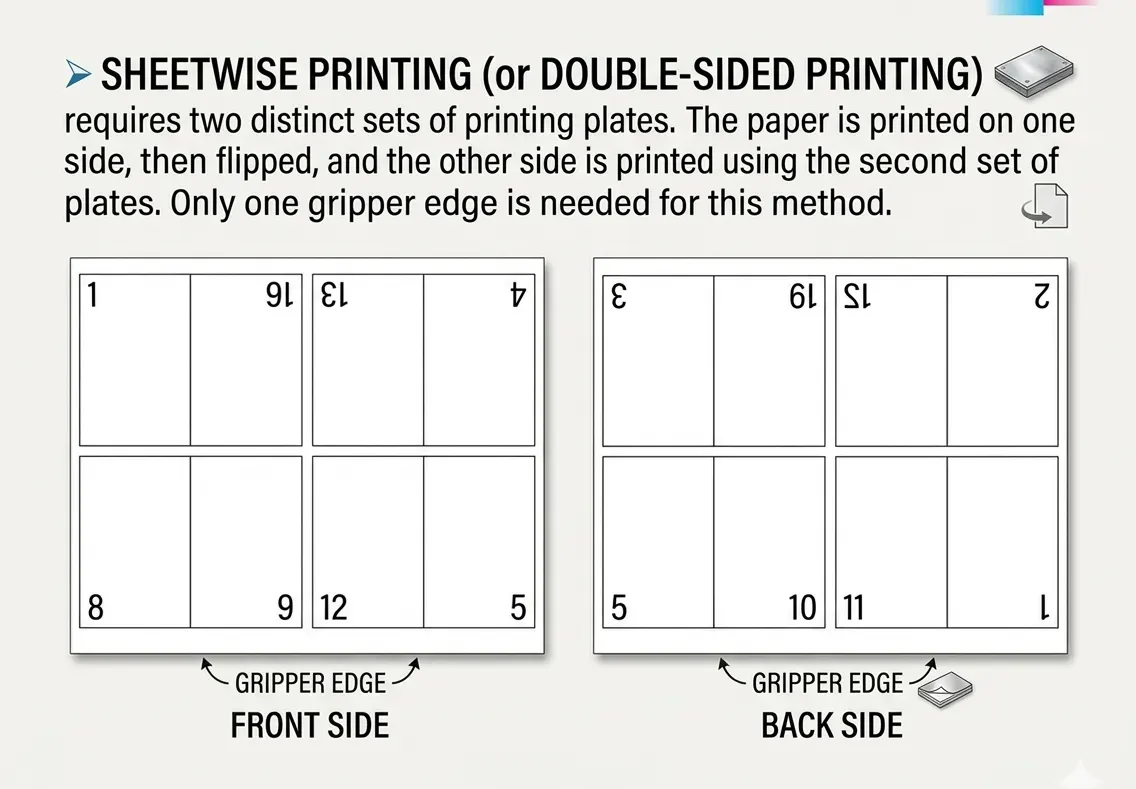
② Sheetwise / Front & Back
The front and back use two different plates. After the first side is printed, the paper is flipped to print the second side using a different set of plates.
③ Work and Turn
This is the most common "self-reversing" method. The front and back layouts are imposed on the same plate.
- Process: The sheet is printed on one side, flipped horizontally (keeping the same Gripper Edge), and printed again on the back.
- Result: Once the sheet is cut in half, you obtain two identical, completed copies. This is highly efficient and saves on plate-making costs.
Similar to Work and Turn, both sides are on one plate, but the sheet is flipped vertically (from head to tail).
Correction & Update: In modern high-speed printing, this method is rarely used because it requires a different "Gripper Edge" for the back side. Unless the paper is perfectly squared and the press is exceptionally precise, it often leads to registration errors (misalignment). It is generally avoided in favor of Work and Turn.
3. Professional Refinements (Corrections)
- Terminology Update: In modern digital prepress, "Iron Wire Binding" is now universally referred to as Saddle Stitching.
- Bleed & Trim: Always ensure a minimum of 3mm bleed is included in the imposition to prevent white edges after trimming.
- Creep Compensation: For thick saddle-stitched books, the inner margins must be adjusted (reduced) during imposition to account for the thickness of the paper "pushing" the inner pages out.
- Color Bars & Marks: Ensure that Color Bars, Registration Marks, and Fold Marks are placed outside the trim area but within the sheet size.