
Producing Casebound Books
Case binding is the technical process for creating hardcover books. The sequence of steps, illustrated in Figure 6-1, remains consistent whether performed manually or with automated machinery.
Folding Signatures and Endsheets
The binding process begins with folding large printed sheets into signatures. A signature is a single sheet folded to create a specific number of pages, such as 8, 16, or 32, which are separated during the final trimming.
Two endsheets are prepared for each book. Each endsheet consists of a strong piece of paper folded in half to form four pages, matching the size of the book's signatures.
These endsheets are glued to the front of the first signature and the back of the last signature using a procedure known as tipping. This step occurs after the signatures have been gathered and sewn.
Gathering Signatures
Assembling signatures into their proper sequence is called gathering. This can be executed by hand or using a gathering machine. The basic operation of a swing arm gathering machine is shown in Figure 6-2.
Sewing
The assembled signatures are fastened together using thread. Two primary sewing techniques are employed: center (Smythe) sewing and side-sewing. Center-sewing saddle-sews individual signatures and binds them together, while side-sewing is typically used for binding loose sheets.
Center Sewing
This technique can be performed by hand or machine. For hand sewing, place gathered signatures between two pieces of plywood. Jog the assembly so the center folds are level and flush with the plywood tops, then insert it into a vise with the folds protruding about one-half inch.
Measure and mark lines on the back of the signatures for positioning three sewing tapes, as shown in Figure 6-3. Each pair of lines should match the width of the tape to be used.
Using a backsaw or dovetail saw, cut along the marked lines into the back of the book until the saw just begins to enter the inner part of each signature, taking care not to cut too deeply.
Position the signatures on a sewing frame and fasten three pieces of sewing tape to the frame with thumbtacks, as illustrated in Figure 6-4.
Remove all but the last signature from the frame and begin sewing it. The needle movement is shown in Figure 6-5: enter through the back at hole 1, exit at hole 2, enter at hole 3, exit at hole 4, enter at hole 5, repeat at holes 6 and 7, and finally exit at hole 8.
Place the next-to-last signature on top and reverse the sewing procedure. When the needle exits alongside a tape, loop the thread around the thread from the previous signature before re-entering, as shown in Figure 6-6. This looping fastens each new signature to the previous one. Tie the two signatures together at the right end.
Repeat this procedure until all signatures are fastened. Additional thread can be tied to the original length if needed. Each time the thread exits at the right, securely tie its end to the previous signature.
Finally, remove the sewn signatures from the frame. Trim both ends of each tape so they extend approximately one inch on each side of the bound signatures.
Side-sewing
Loose sheets of paper may be bound together by side-sewing, using either hand or machine methods.
For hand side-sewing, drill holes through the side of the assembled and jogged pages, as shown in Figure 6-7. Use a 1/16-inch drill, placing the holes as close to the back edge of the paper as possible and at least 1/2 inch from the top and bottom edges of the paper pile.
Sustainability remains a key driver, with increased focus on material sourcing and waste reduction throughout the manufacturing process.
Forwarding. The term forwarding describes a number of things to be done to a book before it can be enclosed in its cover. These operations include smashing, tipping, gluing, trimming, rounding and backing, and attaching super, headbands, and liner.Smashing
Compressing the back edge of the book is called smashing. Smashing is done with a book press or vise.Tipping
Endsheets are attached to the front of the first signature and to the back of the last signature by tipping, Figure 6-8. A narrow band of glue is applied along the folded edge of each endsheet. The endsheets are then adhered to the first and last signatures. Tight contact is required.
Gluing
Apply glue to the back of the book to help keep the individual signatures from shifting. Keep the signatures under pressure until the glue is completely dry.Trimming
Use a paper cutter to trim a book to size. Trim the front edge of the book first. Then trim the top and bottom edges. Do not trim the back of the book.Rounding and backing
Rounding is done to give the back of the book a slightly convex shape, Figure-9.
Place the book on a workbench and hold it as shown. Push on the front edge of the book with your thumb while pulling the outside pages in the opposite direction with your other four fingers. Gently tap the back edge into shape with a bookbinder's hammer. Turn the book over and repeat this process. Be sure to round the back of the book evenly. Only a slight curve is needed.
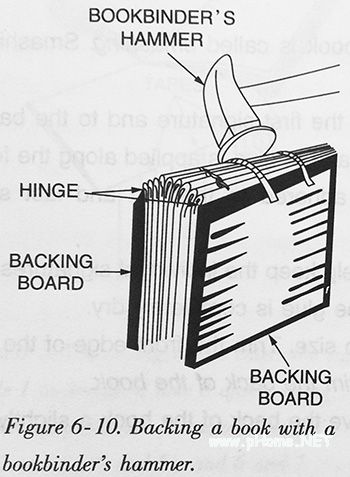
Backing forms a hinge along the front and back sides of the book about 1/8 inch to 1/4 inch in from the bound edge, Figure 6-10. Place the book between backing boards, The rounded edge of the book extending above the top edge of the boards. The actual distance will depend upon the size of the book and on the thickness of its cover. Gently tap the back edge of the book with a bookbinder's hammer, form the two hinges gradually by striking from the center of the back toward the outer edges of the book.
Attaching Super, Headbands and Liner
A bound book with super, headbands, and liner attached is shown in Figure 6-11. Super is a gauze-like material glued to the back of the book. It provides added strength to the finished book. The super should be cut approximately 1/2 inch shorter than the book and about 3 inches wider than its back.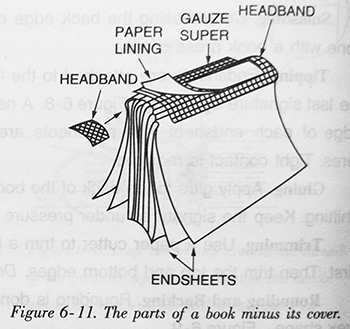
Headbands may also be glued to the back of the book. They are used to decorate rather than add strength to the bound material. Each piece of headband should equal the thickness of the back. Position the headbands so that the decorative portion faces the front edge of the book.
Kraft paper is glued over the super and headbands to finish off the back of the book. This piece of paper is called a liner.
Casemaking
The case is the cover of a hardbound book. It consists of two pieces of binder's board and strip of heavy paper that have been glued to a piece of binding cloth.Casemaking, making the case, can be done by machine or by hand. Casemaking by hand involves cutting the materials to size, gluing the binder's board and paper to the binding cloth, and folding the cloth to cover the edges of the binder's board.
Cutting Materials to Size
Two pieces of binder's board are required. The length of each should equal the height of the book plus the desired cover overhand. Generally, the cover will overhang each edge of the book by 1/8 inch.The width of the binder's board is measured from the hinge that was formed along the back edge of the book, by backing, to its front edge. Be sure to add 1/8 inch to this measurement to provide the needed overhang.
The size of the heavy paper used to line the back of the case is equal to the measurements across the back of the book. Book cloth dimensions are determined by measuring. The height of the cloth should equal the height of the binder's board plus two inches. The width of the cloth is equal to the combined widths of the two pieces of binder's board, plus two inches, plus the width around the back of the book from hinge to hinge.
Gluing Materials in Position
Place the binder's boards and paper liner on the back of the binding cloth as shown in Figure 6-12. Outline the binder's boards and paper liner with a pencil to mark their exact locations. Then remove the binder's boards and paper liner from the book cloth.
With a brush and bookbinding paste, coat the back of the book cloth. Cover the entire surface evenly. Do not leave any lumps of paste. Now carefully position the boards and paper liner on the book cloth. Then turn the book cloth over and squeeze out any excess paste from between the cloth and binder's boards. With a bone folder, press from the center to the outer edges of the boards.
Folding the Book Cloth
Fold the binding cloth up over the edges of th binder's board to complete the case. First fold a corner of the book cloth up over one corner of the binder's board. Then fold the two adjacent sides of th cloth over the board. Use a bone folder to stretch the cloth tightly over the edge of the binder's board. Repeat this procedure at each of the other corners to complete the case.The corners you have just made are called library corners. Although capable of widthstanding considerable abuse, library corners are bulky. Nicked corners are less bulky than library corners. They are formed by cutting away the corners of the book cloth before folding, Figure 6-13. Leave approximately 3/8" of cloth opposite each corner of the binder's board. Continue folding as for library corners.
Hanging the book in the case is called casing-in. Casing-in can be done by hand or by machine.
To hang a book by hand, insert a piece of waxed paper between each of the endsheets. The waxed paper should extend beyond the edges of the book. Waxed paper prevents the endsheets from sticking together when the book is pasted into its case.
Apply paste to the super, tapes, and endsheet located at the front of the book. Position the book within the case, pasted side up, and close the front cover. Then turn the book over, open the back cover and apply paste to the super, tapes, and back endsheet. Now close the back cover. Be sure the book is pressed up against the back of the case and in its proper position. Readjust the position of the book if necessary.
After hanging the book, place it between two pressing boards. The metal strip on each board should be fitted into the book's hinge.
Place the pressing boards and book assembly into a book press until the paste is completely dry. The pressing operation is shown in Figure 6-14. When dry, the book can be removed from between the pressing boards. Clean off the excess glue as required. The book is now complete.