
Choosing Consumables for a Single-Color Offset Press
Why Single-Color Machines Allow Different Choices
A single-color offset press lays down one ink at a time. Because only one printing unit runs per pass, the demands placed on consumables are easier to meet than on a four-color machine, where four units, four blankets and four ink trains have to hold the same register and density across a long run. On a single-color press a shop can accept a wider tolerance and often pay less. That flexibility is not a reason to buy carelessly. Cost, print quality and value still decide whether a cheap consumable saves money or quietly costs more in waste, downtime and reprints.
Feeder Consumables: Suction Pads
The only feeder item a single-color shop buys on a regular basis is the suction pad. Pads are sold in three thicknesses: thick, standard and thin. In practice all three can handle the full range of paper stocks. Even the thinnest pad will lift the heaviest board, though a thin pad can fail to pick up a sheet when the stock is dense and the pile is heavy. Adjusting the suction head height and the air volume normally closes that gap, so thickness matters less than the operator's willingness to set the feeder properly. Standard thickness covers the widest range of jobs and is the safest stock item. Expect to pay roughly 0.3 to 1 yuan per pad, depending on supplier and quantity.
Feed Board Parts: Brush Wheels and Tapes
Brush wheels and tapes on the feed board wear at different rates depending on paper grade, dust and running speed, so they are chosen by observation rather than by catalogue. Smaller brush wheels are the better default. A smaller wheel deforms less as it presses the sheet down, and a wheel that keeps its shape keeps the sheet path steadier. Tapes should be replaced as soon as they glaze or lose grip. A polished tape is a common source of misfeeds that operators blame on the feeder.
Ink Selection
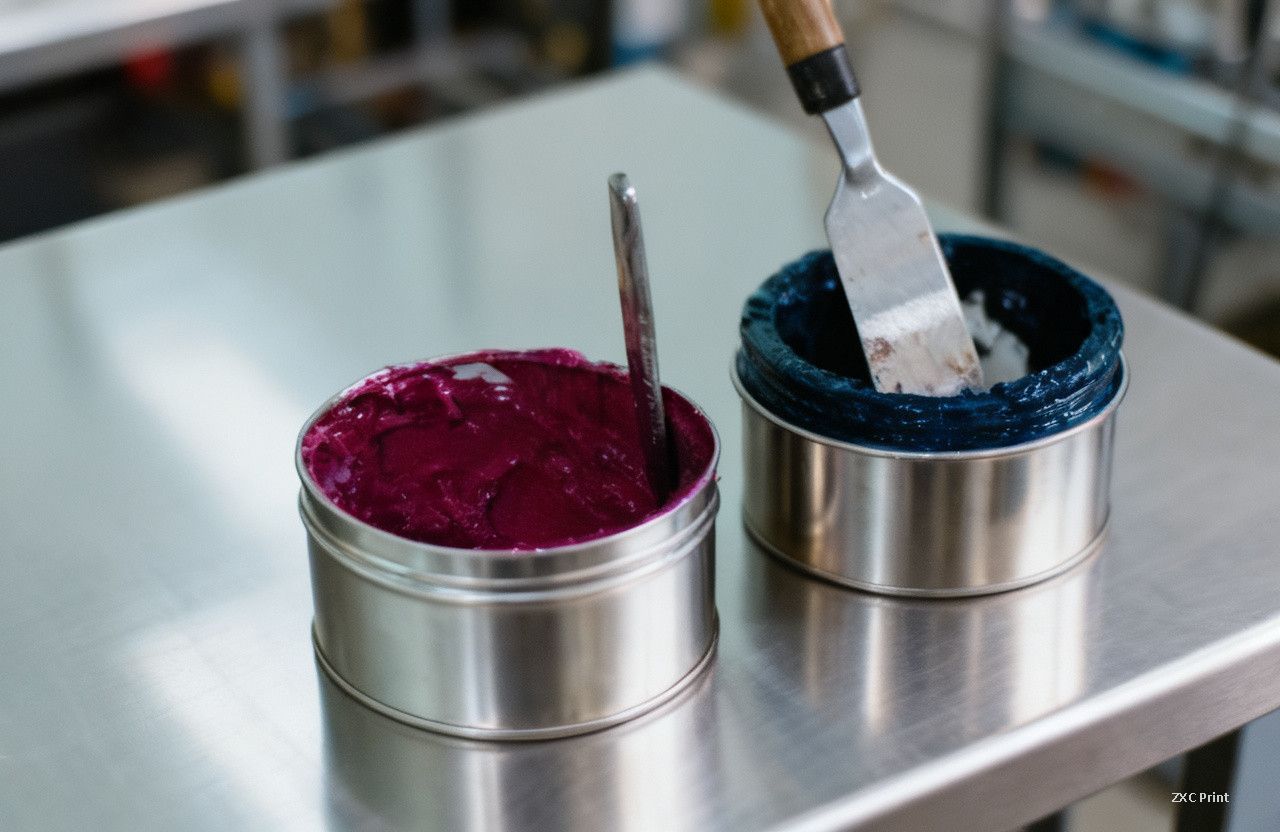
Ink is the consumable that decides the printed result, and it deserves the most attention. Many shops running single-color work standardize on Mudan ink. It sits at a good balance of price and performance, holds its properties consistently across a run, and comes from a long-established manufacturer. A further practical point is supply: many distributors carry the brand, competition keeps the price honest, and margins stay thin enough that a shop can change supplier without changing formulation. Other inks worth sampling include Tianjin Tianshi, Shanghai Huaxing and Hangzhou Hanghua.
Ink Auxiliaries
Auxiliaries fall into three families: ink oil, viscosity reducer and ink additive. Ink oil is the one used most often. It is inexpensive, it works, and most jobs that need a softer or longer ink can be handled with it alone. Viscosity reducer and ink additive cost more per litre. Where a job calls for a tack reduction and no reducer is on the shelf, ink additive can stand in for viscosity reducer. The two behave much the same way in the fountain, though an operator should still test on a short run before committing a full job.
Fountain Powder
Fountain powder is a small item with a large effect. Some pressmen believe that more powder means better printing. The opposite is closer to the truth: an excessive dose attacks the PS plate and shortens its life, so a plate that should have run for tens of thousands of impressions may fail early. Powder does help hold back scumming, but that is a secondary job. Its main function is to keep the dampening water fine and even, stabilizing surface tension so the water film stays where it is placed instead of creeping across the plate.
Plate Correction Supplies
Correction paste, correction liquid and correction pens cover different working positions. A platemaking room benefits from the paste, which covers deletions and additions over a larger area with better control. Press operators are better served by a pen, which reaches small defects on a mounted plate without pulling the job. Buy both, and keep them apart to avoid cross contamination.
Plate Cleaners and a Note on Economy
Plate cleaning paste and plate cleaning liquid differ widely in price. A practical way to reduce consumption is to wipe with a sponge instead of a cloth. A sponge holds water well, so a bucket of clean water next to the press lets the operator rinse the sponge after each wipe. Over a shift, the cleaner still held in the sponge dissolves into the bucket, and the solution can be reused. One shop was documented running a single machine on two boxes of cleaning paste a month by reusing the same bucket until the water turned foul. It saves money, though common sense and workshop hygiene set the limit on how far to push it.
PS Plates
Plate choice follows volume and quality target. A shop producing simple work in short batches of a few thousand sheets can finish the job on recycled plates and never see a complaint, since a single-color press is not usually held to the tightest quality standard. Shops that print demanding work often accept nothing but a named brand such as Huaguang. Where volume is high the cost of a better plate is spread across more impressions, and the case for quality stock becomes easy to argue.
Blankets and Restorers
Blankets are worth buying well. Brands such as Dico from the United States and Vulcan from Italy sit among the best available. Under normal use a good blanket runs for months without replacement, which makes the higher purchase price easy to absorb. Shops that run heavy board all year will crush blankets regardless of brand, and for them a domestic blanket is the sensible choice. Restorers come in two types. A cleaning restorer is cheap, around ten to twenty yuan a bottle, and gives a modest result. A strong paste restorer costs 60 to 80 yuan and works much better. The decision depends on the blanket in question: a bottle of strong restorer can cost as much as a new blanket.
Sundries Worth Keeping on the Shelf
A few small items save trouble when they are already in the cabinet. Descaler removes the crystallized ink residue that builds on roller surfaces. It clears most of the deposit in place, and only a badly crystallized roller needs to come off the press for a toluene wipe. Anti-skinning agent reduces wash consumption, though it is a poor substitute for cleaning. If a press will stand idle for more than four hours, wash the rollers rather than rely on an additive. Idle protection agent and blanket wash round out the list.
Spray Powder
Spray powder is matched to the job, not bought by habit. Particle size follows ink film weight, board thickness and surface smoothness, so a coated sheet carrying a light film needs a finer powder than a heavy uncoated board. Where the printed piece will contact food, such as a tray liner, specify a non-toxic grade that meets the food contact requirement. Getting this wrong is one of the few consumable decisions that can turn a saleable job into a rejected one.