
How Ink Properties Affect Offset Print Quality
When you order offset printing, the ink on the press is the last and often most overlooked variable that determines how your finished piece looks. The same file can come off the press looking vivid and crisp, or dull, patchy, and prone to smudging, and much of that difference comes down to the properties of the ink itself. Understanding how ink behaves helps print buyers, designers, and self-publishers know what to expect, how to talk to their printer, and why problems such as color shift, picking, or smeared pages happen in the first place.
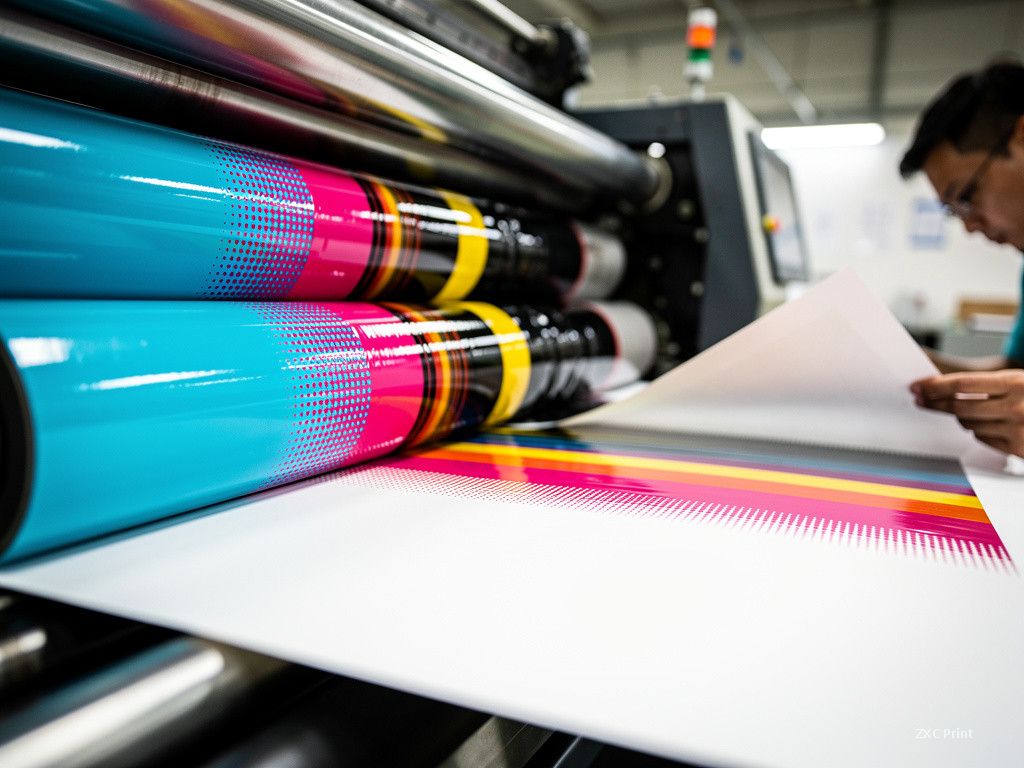
Color performance: what determines accurate color
The color-rendering ability of ink directly affects the saturation and hue accuracy of the final print, and four parameters matter most. Color strength (also called color concentration) expresses how much color a given amount of ink can deliver; it affects neutral gray balance and the accurate reproduction of secondary and composite colors. Hue error measures the amount of incorrect absorption that disturbs the dominant hue. Grayness indicates how much of the light absorbed is shared across all three color regions, which dulls the color. Color efficiency is the ratio of actual reflected light to ideal reflected light, summarizing how selectively the ink absorbs. Together these four values depend on the pigment's hue, tinting strength, density, fineness, reactivity, solubility, oil absorption, and hiding power.
Rheology: tack, viscosity, and fineness
Rheological properties (tack, viscosity, fineness, and adhesiveness) govern how ink transfers from the blanket to the paper. If tack is too high, the ink film pulls fibers off the paper surface during printing, causing the well-known "picking" defect; printers usually correct this by adding a thinning solvent or mineral oil. Excessive viscosity leaves the pigment under-dispersed: particles clump together, transfer becomes uneven, and ink fails to pass through the screen properly. Low viscosity means too much solvent and too little resin and pigment, so the ink cannot form a smooth film on drying. The result is a dull, low-saturation appearance. Fineness matters too: ink that is not ground fine enough causes uneven solids, grainy prints, and shortened plate life, while fine ink gives crisp, full dots and stronger tinting strength.
Emulsification and the water-ink balance
Offset printing relies on a water-ink balance, and the emulsification behavior of ink determines whether that balance holds. Ink must tolerate a certain amount of dampening solution; when the water supply is too small, the ink absorbs all the fountain solution and the emulsification rate rises quickly, destabilizing ink transfer. When water and ink are in balance, the ink transfers cleanly, dots stay sharp and uniform, images are detailed, and colors are vivid, while non-image areas remain clean. If the balance is lost, you may see scumming on blank areas, weak and lifeless print, and heavy emulsification, all of which degrade quality noticeably.
Drying behavior and set-off
Slow drying causes one of the most common complaints: set-off, where ink from one sheet transfers onto the back of the sheet stacked above it. This tends to happen in solid or dark shadow areas that carry a heavy ink film. Set-off can occur when the reverse side is printed immediately after the first side, or later, when finished sheets are stacked or bundled before the ink has fully cured. In practice, printers control drying speed through ink formulation, fountain solution settings, and the use of spray powder between sheets.
Lightfastness: how long the color lasts
Under light, pigments gradually fade. Light colors such as yellow are usually the first to go, because their molecular structure contains many unsaturated bonds that break down under UV exposure. For books and marketing materials that are expected to last, ink lightfastness is a real quality factor. If a print is meant to sit on a shelf or be displayed for years, ask your printer whether the inks used offer adequate lightfastness for the intended lifespan.
What this means for print buyers
You rarely control ink selection directly, but you can ask the right questions. A reputable printer running consistent, quality-controlled offset printing will hold stable color, avoid picking and set-off, and use inks matched to the paper you choose. When you review proofs, check for graininess in solids, weak color in light areas, and any sign of scumming. These are early indicators of ink problems that will only get worse in the full run.