
Why Print Colors Look Washed Out: Prepress Mistakes and Fixes
You send a file to the printer expecting rich, saturated color, and the finished job comes back flat and washed out. The press usually takes the blame, but the real cause often sits one step earlier in prepress. Plate-making errors quietly change dot size and image density before a single sheet is printed, and by the time anyone notices, the job is already running.
How plate-making errors change color
In the film era, plates were exposed through photographic film, and the film's emulsion side had to lie directly against the plate. If the emulsion faced the wrong way, the transparent film base sat between the image and the plate, and light scattered around the edges of fine dots, lines, and text during exposure. The plate then carried smaller dots with lower density, and the print came out visibly lighter. A typical failure looked like this: a four-color job where a 20 percent flat blue screen printed noticeably pale, leaving the whole sheet short of blue compared with the original. The fix was to erase the solid text and line work on the plate with correction fluid, then reprint the flat screen area in register, which brought the color back close to the original.
Computer-to-plate workflows have removed film and its emulsion problems entirely. The principle survives, though: the image side of the plate must face the right way, and the dots on the plate must match the file. Plates can still be exposed, developed, or handled incorrectly, and the symptoms look the same: light screens, weak color, and soft detail.
Reading halftone dots by eye
Halftone dots are the building blocks of printed color. A 50 percent screen means dots and white space each cover half of the area. You can estimate dot percentage by looking at the gap between two opposing dots. If three dots of equal size fit in the gap, the screen is about 10 percent. Two dots means 20 percent, one and a quarter dots means 40 percent, and one dot means 50 percent. Above 50 percent, reverse the logic and count the white gaps instead. The pattern is symmetrical: a 60 percent screen has the same structure as a 40 percent screen with dots and gaps swapped.
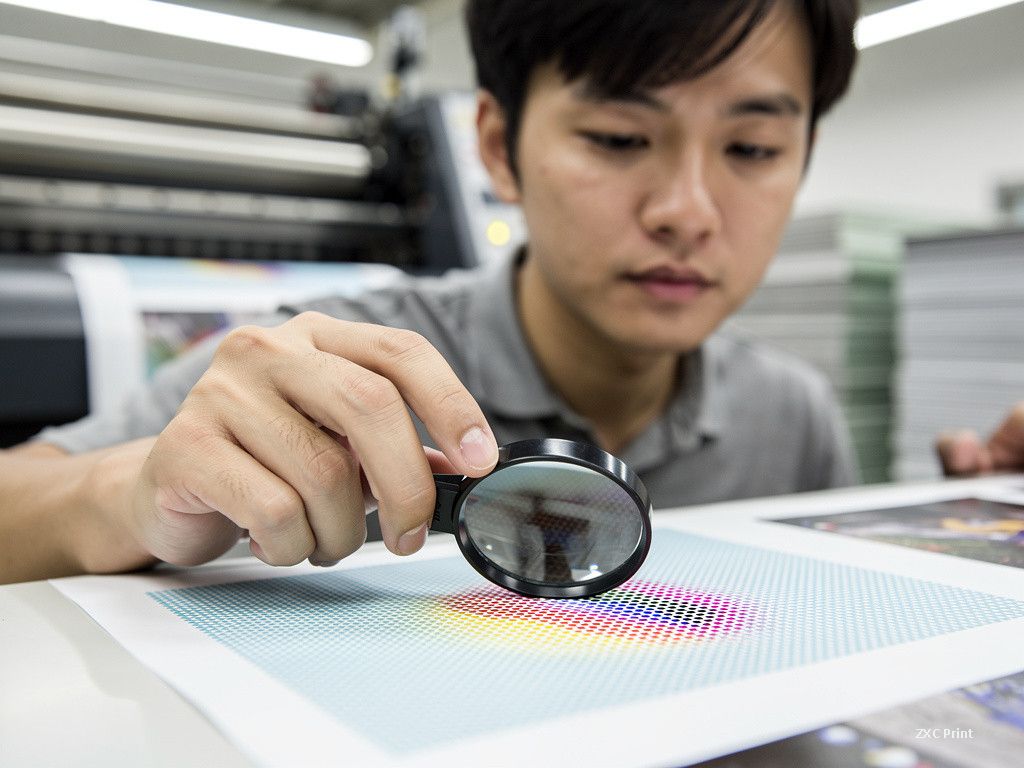
This skill matters because a wrongly made plate produces visibly smaller dots. Checking the plate or the first press sheets with a magnifier, often called a loupe, reveals the problem before a full run is wasted.
What buyers should watch for
If your job comes back lighter than expected, ask your printer three questions. Were the plates remade or verified? What does the ink density read on a densitometer? How much dot gain is built into the color profile? A professional shop will show you press sheets and proofs, and will correct the problem rather than argue about it.
On your side, keep expectations realistic. A 20 percent flat screen always prints lighter than it looks on a bright monitor, because paper absorbs ink and screens lose a little density in transfer. Approve a proof under normal lighting, compare it with the final sheets, and flag color issues early, when reprinting one plate is cheap and easy.
Prepress quality control is the cheapest insurance in color printing. When the plates are right, the press has a fair chance, and your job keeps the color you approved. That is the difference between a smooth run and a reprint nobody planned for.