
Paper Ream Weight and Reams per Ton: A Quick Conversion Guide
When you order printing, the paper is usually quoted in grams per square meter (gsm), which describes the basis weight of a single sheet. Freight and cost, however, depend on how much an actual stack weighs. Ream weight, the weight of 500 sheets in a given size, is the figure that connects the two. This guide explains how it is calculated and gives a ready conversion table for the sheet sizes most common in Chinese print shops.
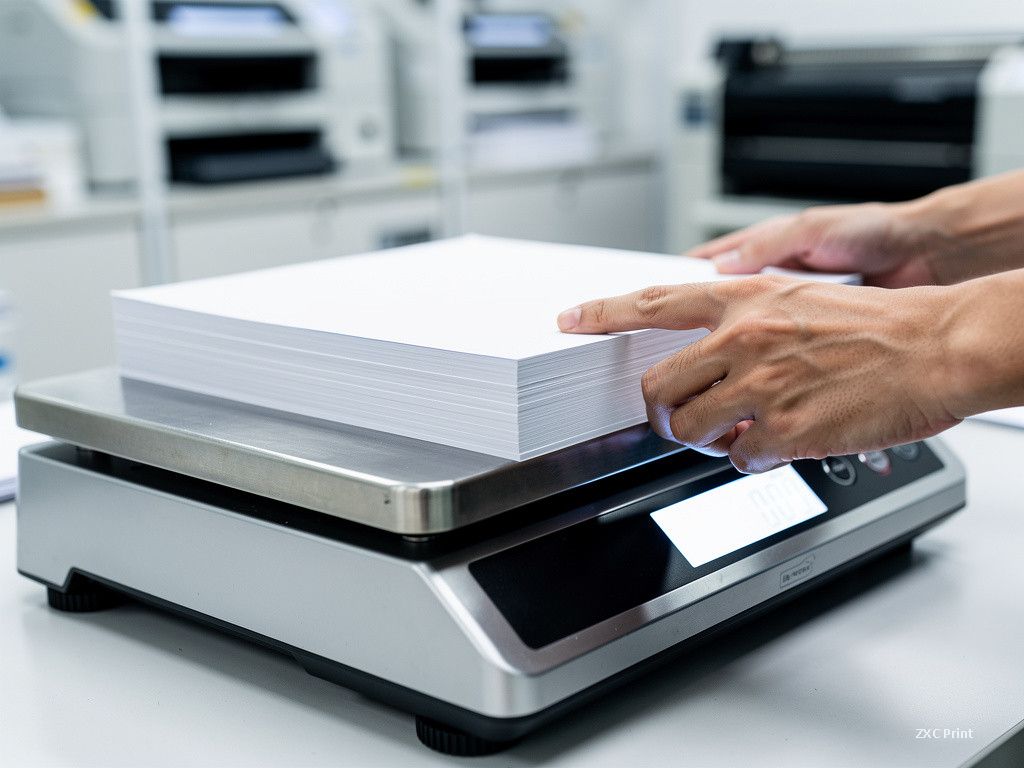
Most printing paper is counted in reams of 500 sheets. To find the ream weight in kilograms, multiply the sheet area in square meters by the gsm, then by 500 and divide by 1000. In one step, ream weight (kg) = gsm × length × width × 0.0005, with length and width in millimeters. The factor for a fixed sheet size never changes, so shops memorize a single constant for each size. For 889 × 1194 mm, that constant is 0.5307. A 128 gsm sheet in this size gives 128 × 0.5307 = 67.9 kg per ream, and 1000 ÷ 67.9 = 14.7 reams per ton.
Conversion table for standard sheet sizes
The table below lists ream weight in kilograms and reams per ton for five sheet sizes that are standard in China: 787 × 1092 mm, 787 × 1194 mm, 850 × 1188 mm, 889 × 1194 mm and 880 × 1230 mm. Values are rounded to one decimal place.
| gsm | 787 × 1092 mm | 787 × 1194 mm | 850 × 1188 mm | 889 × 1194 mm | 880 × 1230 mm |
|---|---|---|---|---|---|
| 60 | 25.8 kg (38.8/t) | 28.2 kg (35.5/t) | 30.3 kg (33.0/t) | 31.8 kg (31.4/t) | 32.5 kg (30.8/t) |
| 80 | 34.4 kg (29.1/t) | 37.6 kg (26.6/t) | 40.4 kg (24.8/t) | 42.5 kg (23.5/t) | 43.3 kg (23.1/t) |
| 100 | 43.0 kg (23.3/t) | 47.0 kg (21.3/t) | 50.5 kg (19.8/t) | 53.1 kg (18.8/t) | 54.1 kg (18.5/t) |
| 128 | 55.0 kg (18.2/t) | 60.1 kg (16.6/t) | 64.6 kg (15.5/t) | 67.9 kg (14.7/t) | 69.3 kg (14.4/t) |
| 157 | 67.5 kg (14.8/t) | 73.8 kg (13.6/t) | 79.3 kg (12.6/t) | 83.3 kg (12.0/t) | 85.0 kg (11.8/t) |
| 200 | 85.9 kg (11.6/t) | 94.0 kg (10.6/t) | 101.0 kg (9.9/t) | 106.1 kg (9.4/t) | 108.2 kg (9.2/t) |
How to use the numbers
Ream weight turns a paper quote into a real shipping estimate. If you know the total number of sheets, divide by 500 to get reams, then multiply by the ream weight for the exact tonnage. The reams-per-ton column works in reverse, telling you how many reams fit into one metric ton, which helps when a supplier prices by weight. Keep the sheet size straight, since the same gsm weighs noticeably more in a larger format.
Paper absorbs moisture, so real reams drift a small percentage around the theoretical value. Mills and converters normally allow a tolerance of a few percent, and conditioned paper in a stable print room comes closest to the nominal figures. When comparing quotes from different suppliers, ask for the ream weight behind the price, since the gsm alone says little about real weight. The same basis weight in the same size should weigh the same, and a quoted ream weight far from the table below is worth questioning.
For most book and catalog work, 80 to 128 gsm covers text pages and 157 to 200 gsm suits covers. Checking paper weight before you approve a proof saves surprises at the freight stage, and it makes budget comparisons between printers much easier.