
A press that performs well month after month is rarely the one with the newest components. It is the one whose operator treats care as a routine: checking, oiling, listening and adjusting before a small fault grows into lost production. Offset machines reward this discipline because accuracy lives in parts that wear quietly, such as gears, cams, cylinders, bearings and springs.
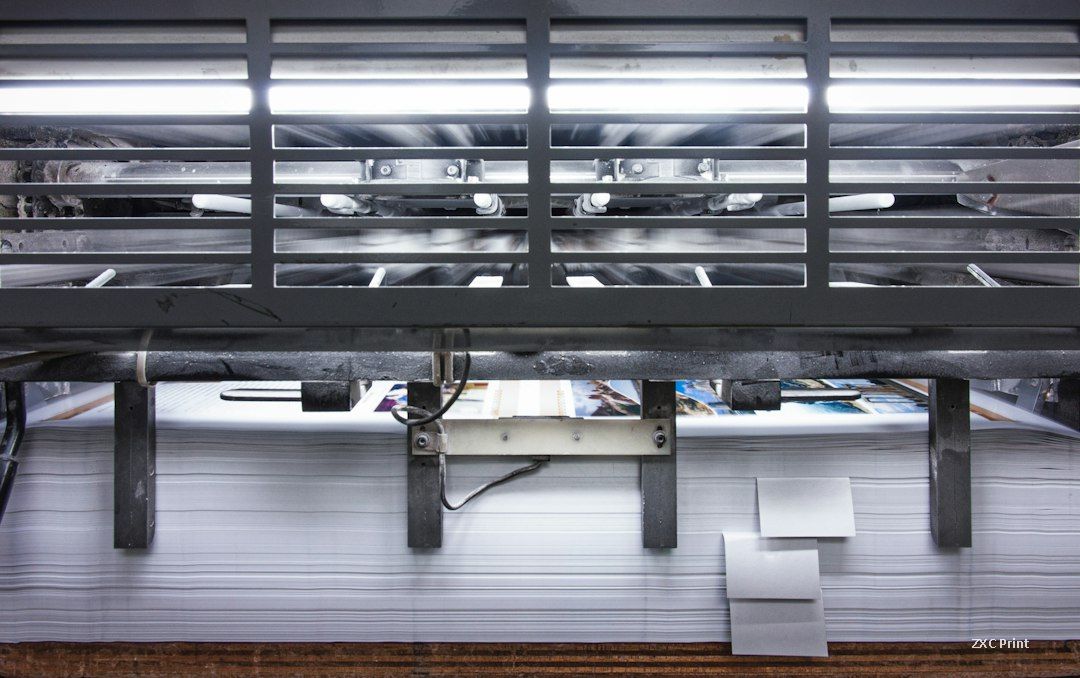
Static care begins with a written routine
Static maintenance covers everything done while the machine is stopped. The press manual should be the reference document, and the workshop should turn it into a schedule that names the interval, the person responsible and the record kept. Typical items are oil changes at fixed running hours, cleaning of filters and oil strainers, and periodic checks of machine precision with a dial gauge or test form.
Important assemblies deserve more attention than the rest. Gears, cams, chain wheels, cylinders and bearings decide the final print quality, so their condition should be measured rather than guessed: backlash, radial play, surface scoring and lubrication state all belong on the checklist. Springs carry the force balance in many mechanisms, and their behaviour sets how precisely moving parts meet. A spring needs elastic response; hysteresis and permanent deformation ruin that response, and a spring that has taken a set should be replaced at once rather than adjusted.
Maintenance also belongs in design decisions. A press should be laid out so that filters, grease points and drive covers can be reached without dismantling guards. Because a real machine cannot anticipate every condition, and because workshop conditions change with seasons and materials, structures that make service difficult should be improved when the change does not disturb normal running.
Dynamic care covers what happens while the press turns
Dynamic maintenance is the care given while the press is running, and it rests on the static work: a machine that was set up properly is the only one worth testing in motion. Running condition then feeds back into the next static check.
Start with readiness. Inching the press by hand or at low speed reveals obstructions such as a tool left inside the frame, a plate that is not seated correctly, or a blanket fitted badly. A misplaced plate can be damaged and makes register work far harder; a loose blanket can cause print faults and, in bad cases, damage the blanket or the press itself.
Lubrication comes next. The oil sight glass shows whether the circuit is flowing; if it is empty or clouded, stop the press and trace the cause, because a leak is easy to see but hard to locate once oil has spread. Machines with plain bearings lubricate poorly at low speed, so idle the press briefly to prime the circuit before inching or slow running, which is the first job of every shift. On presses whose oil pump is driven by the main motor, running in reverse pulls oil back into the tank instead of feeding the bearings, so reverse jogging should be avoided. Bearing temperature near critical points is a useful secondary check: a hot housing points to a lubrication problem.
Finally, watch the impact load. Smoother running extends machine life, and lower printing pressure, within the limits set by print quality, keeps the train steady. Reducing speed lowers rotational inertia, so a press should not be left at maximum speed for the whole shift.
These habits are only part of daily care, but they decide how long the press serves and how consistent its output stays.