Understanding Photosensitive Materials for Screen Printing
Screen printing relies on photosensitive emulsions to create durable, high-resolution stencils on mesh screens. The quality of these materials directly affects print sharpness, run length, and screen reusability. For print buyers and designers who work with screen printing vendors, understanding the key requirements of photosensitive materials helps in selecting the right process for each project.
Requirements for Stencil Making
Coating and Handling Properties
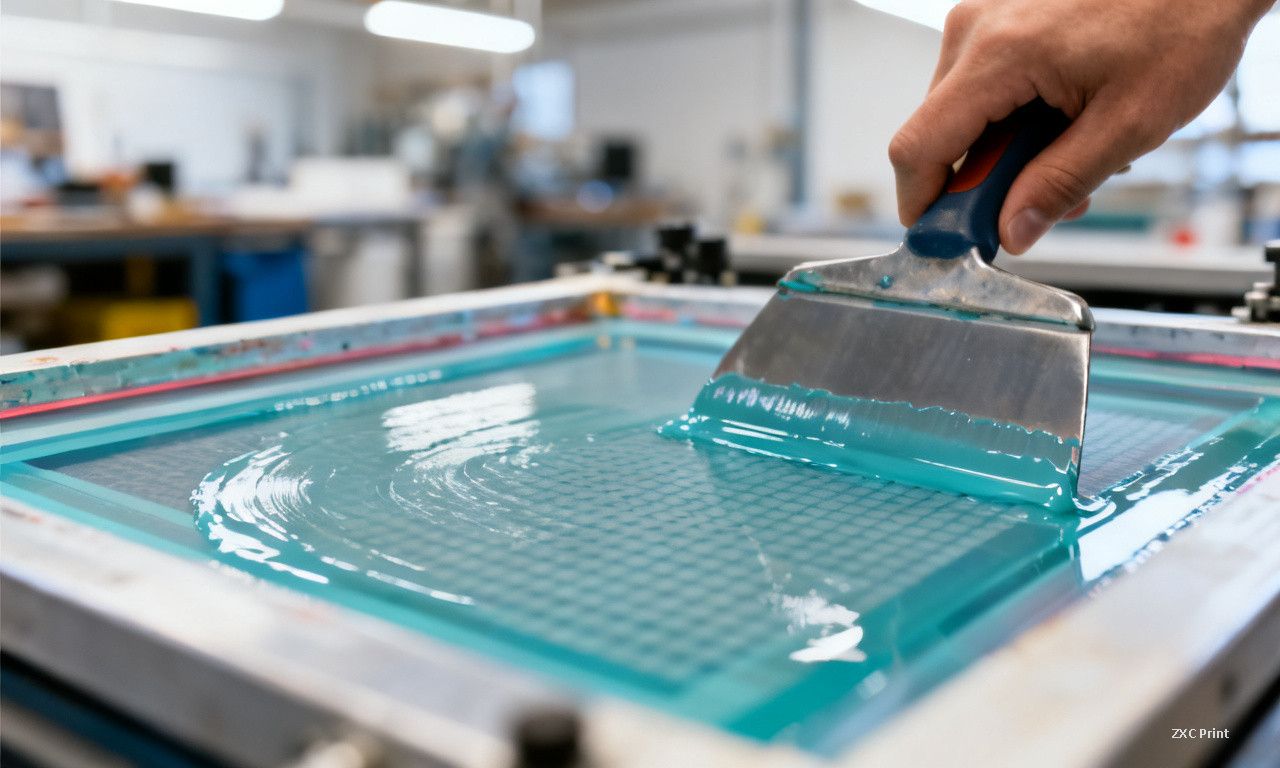
A good photosensitive emulsion must be easy to apply evenly across the mesh. It should flow smoothly during coating and dry to a uniform thickness without pinholes or streaks. The emulsion should also remain stable during storage, with a reasonable shelf life under proper darkroom conditions. This reduces material waste and ensures consistent results across multiple screens.
Spectral Sensitivity and Exposure
The ideal photosensitive range for screen printing emulsions falls between 340 and 440 nanometers. This UV-to-violet region balances sensitivity with practical handling. Shorter wavelengths require specialized light sources and stricter safety measures for operators. Longer wavelengths may cause the emulsion to react to ambient light, making darkroom conditions harder to maintain. Emulsions with high sensitivity within this range allow faster exposure times and lower energy consumption, which improves workflow efficiency.
Development and Resolution
After exposure, the unhardened emulsion must wash out cleanly to reveal the open mesh areas of the stencil. Good development properties mean clean edges, no residue in fine details, and fast washout times. The resolution of the stencil (the finest line or dot it can reproduce) depends on the emulsion particle size and its response to the exposure process. High-resolution emulsions are essential for detailed artwork, fine text, and halftone screens commonly used in commercial print projects.
Requirements During Printing
Ink Compatibility and Durability
The cured stencil must resist the chemicals and solvents in different ink types. Water-based inks, plastisols, UV-curable inks, and solvent-based inks each place different demands on the emulsion. A high-quality stencil maintains its integrity through repeated squeegee passes without breaking down or releasing particles into the ink. Print durability (measured in number of impressions before stencil failure) is a key specification for production runs. For high-volume jobs, a durable emulsion reduces downtime for screen reclamation.
Adhesion to Mesh
Strong bonding between the emulsion and the screen mesh prevents stencil delamination during printing. When the squeegee applies pressure, the stencil must stay firmly attached to the mesh strands. Weak adhesion causes stencil lifting, ink bleeding under the stencil, and defective prints. Proper mesh preparation (degreasing and roughing) before coating helps maximize adhesion.
Stencil Removal and Screen Reuse
After the print run, the stencil should strip cleanly from the mesh without leaving ghost images or residue. Easy reclaimability reduces screen preparation time and extends the life of the screen fabric. Some emulsions are designed specifically for easy removal, which is an important consideration for shops that reclaim screens frequently.
Film Thickness Considerations
The thickness of the cured emulsion on the printing surface directly affects ink deposit. For opaque inks (such as white inks printed on dark substrates), a thicker stencil is required to achieve proper coverage. Typical film thickness for opaque ink applications ranges from 10 to 40 micrometers, roughly equivalent to one or two sheets of standard copy paper. Thinner stencils are used for translucent inks, fine detail work, and applications where minimal ink build is desired.
Common Issues and How to Avoid Them
Poor emulsion selection or application leads to several common problems. Underexposure causes the stencil to wash away during development. Overexposure makes washout difficult and reduces fine detail. Inconsistent coating thickness results in variable ink deposits across the print. Using an emulsion that is not compatible with the ink chemistry can cause rapid stencil failure mid-run. Working with an experienced print provider who selects the right emulsion for each job prevents these issues and delivers consistent print quality.