
In offset printing, the quality of your printed piece depends heavily on the paper you choose. Understanding how paper properties interact with ink and press conditions helps you make better decisions for your print projects. Five key paper characteristics have the most direct impact on the final result.
Paper Smoothness and Print Quality
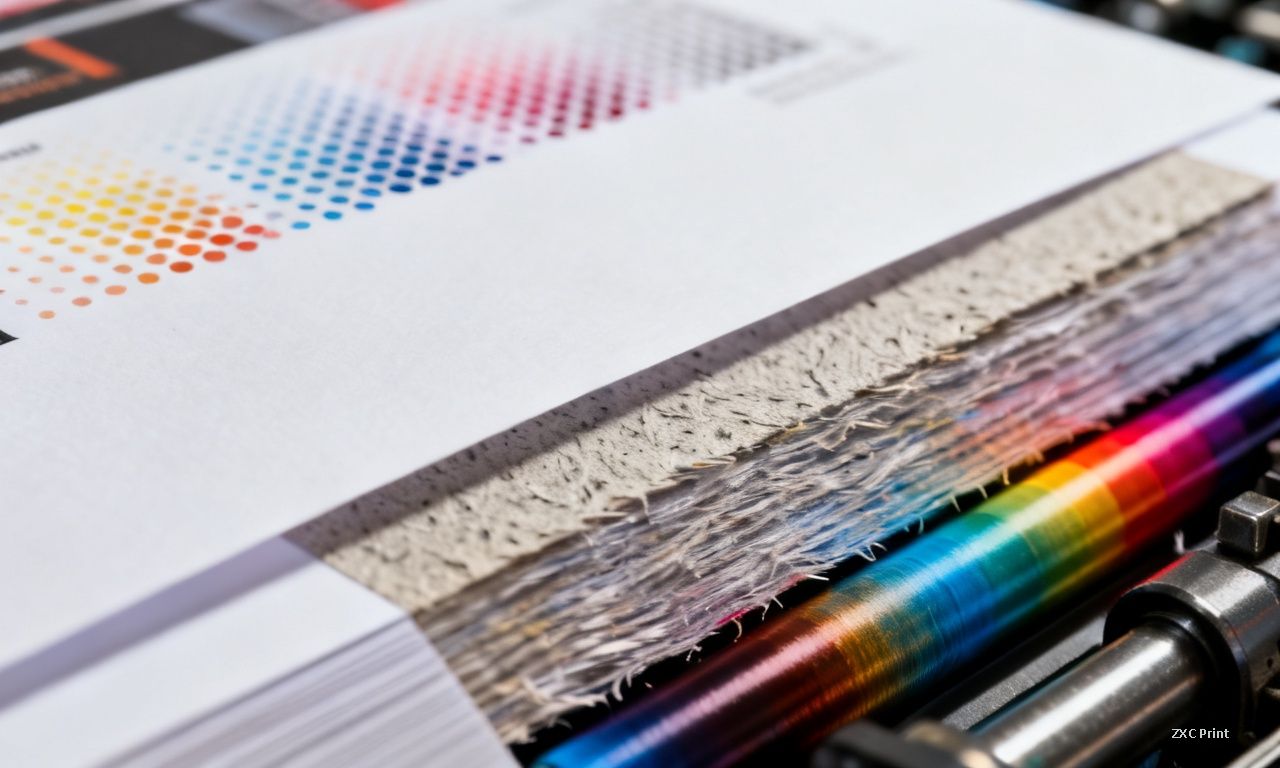
Paper smoothness determines how evenly the printing plate contacts the paper surface. High-smoothness paper, typical of coated stocks, allows fine halftone dots to reproduce accurately, giving sharp details and smooth gradients. Low-smoothness paper has microscopic valleys that can make small dots break up or disappear, leading to uneven image reproduction.
However, very high smoothness comes with trade-offs. Smooth paper is usually made through heavy calendering or filling, which increases paper density but reduces elasticity and ink absorbency. This can cause set-off (ink transferring to the back of the sheet above) and, under high pressure, may spread ink dots wider than intended. When working with papers of noticeably different smoothness levels, printers should group them by grade and adjust pressure and ink volume to maintain consistent results.
Ink Absorbency and Its Effects
Ink transfers to paper through a combination of mechanical pressure and capillary action within the fiber network. When the press cylinder applies pressure, fiber gaps compress; after the pressure releases, the paper springs back and draws ink into its surface. Papers with loose fiber structure absorb ink quickly, requiring lighter pressure and reducing plate wear. But overly porous paper can cause problems: if ink tack is too high, fibers may be pulled from the surface (picking); if ink viscosity is too low, the vehicle penetrates deeply, leaving pigment on the surface and causing strike-through or loss of gloss.
Dense, low-absorbency papers work best for color printing because the ink vehicle stays near the surface, keeping pigments bound and colors vibrant. The downside is slower drying and a higher risk of set-off or crystallization. Printers typically match ink formulation to the paper absorbency level for best results.
Paper pH and Ink Drying
Paper pH affects how offset ink cures. Acidic paper reacts with driers, forming compounds that slow or stop oxidative drying. Acidic papers need more drier additive to compensate. Neutral or slightly alkaline paper promotes faster drying.
For offset printing, paper pH also interacts with fountain solution chemistry. Alkaline paper can dissolve alkaline substances into the fountain solution, neutralizing its acidity and destabilizing the ink-water balance. This can cause ink emulsification, toning in non-image areas, and dull-looking colors. The more acidic the fountain solution, the stronger this interaction becomes, potentially accelerating plate wear as well.
Paper Formation Uniformity
Paper formation refers to how evenly fibers and fillers are distributed through the sheet. In coated papers, poor base-sheet formation causes the coating binder to penetrate unevenly into the base, creating patches of different absorbency. The final coating layer then absorbs ink inconsistently. This effect is particularly noticeable with blade-coated papers, where the coating layer uniformity depends heavily on the base sheet evenness.
Uneven formation leads to mottled print, inconsistent color density across the sheet, and visible variations in gloss. High-quality printers always check formation before running large color-critical jobs.
Surface Strength and Picking Resistance
Paper surface strength is its ability to resist fiber and coating-particle pull-out during printing. When surface strength is insufficient, the tack of the ink lifts fibers (linting) or coating particles (dusting) from the paper surface. These particles accumulate on the blanket and printing plate, causing hickeys - white spots where ink should be. The printed image becomes uneven, with visible defects, reduced gloss, and overall quality degradation.
Surface strength matters most in solid-coverage areas and when using high-tack inks. Testing surface strength before production runs helps prevent costly press stops for blanket washing.
Practical Takeaways
When planning your next print project, consider paper grade carefully. For jobs requiring fine detail and vibrant color, choose smooth, dense coated paper. For text-heavy publications where readability and drying speed matter, a neutral-pH uncoated paper may serve better. Always communicate your paper requirements to your printer early, and request a press proof on your chosen stock before committing to the full run.