
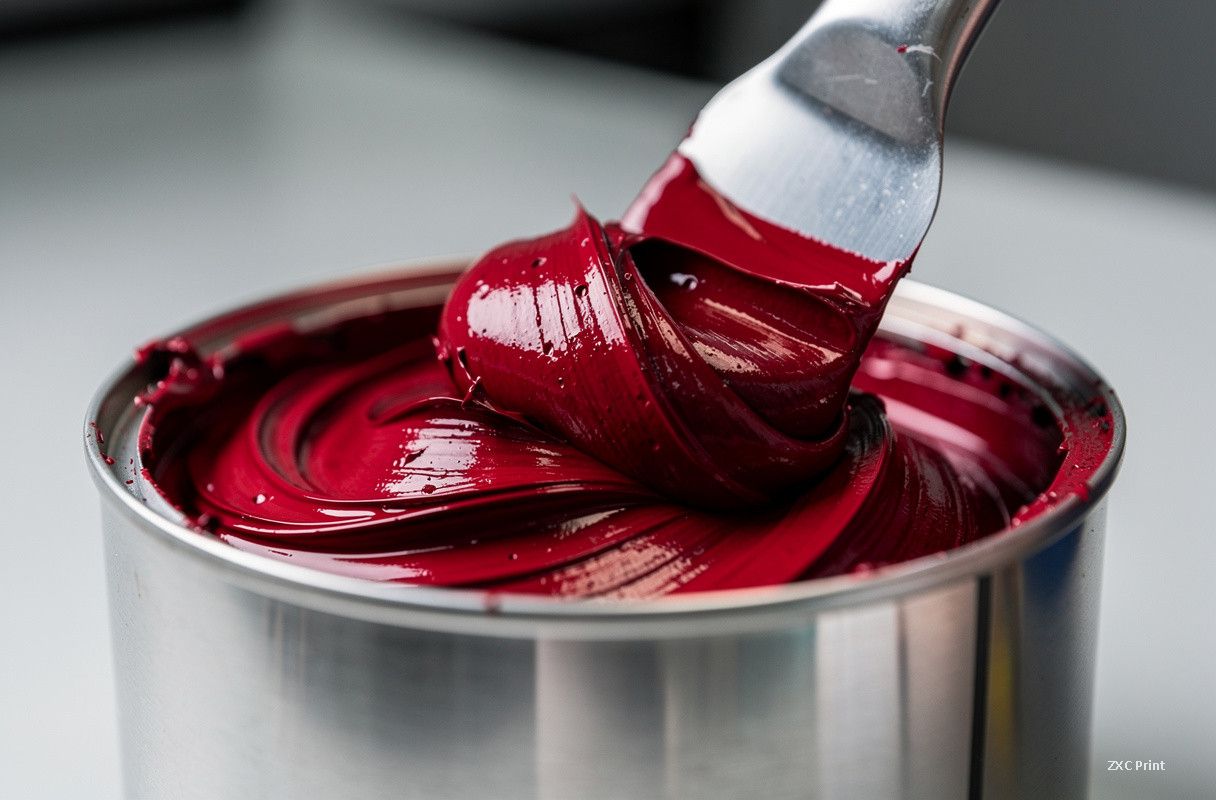
Ink gelation is a fault that printers and ink makers have dealt with for decades. It appeared most often in older oil-based inks, the kinds that dry by oxidation or by penetration into the paper. Solvent-based inks, which dry by evaporation, and water-based inks run into it less frequently, but they are not immune. The causes are complex, and some of them trace back to the manufacturing procedure itself, such as whether the drier was added early or late in the batch. Understanding how gelation starts is the first step toward preventing it.
What Ink Gelation Looks Like
When an ink gels, it turns thick, stringy, or lumpy. It stops flowing evenly from the fountain or the anilox roller, transfers poorly to the plate and substrate, and may refuse to leave the container. In extreme cases, the ink sets into a mass that cannot be stirred back into a usable state. The fault can appear during production, during storage, or after the can has been opened on the pressroom floor.
Six Causes of Ink Gelation
Technicians who study the problem generally group the causes into six items:
1. The resin molecular weight in the system is too high, which pushes the viscosity past a workable level.
2. The solid content is too high, even when the resin vehicle itself has a low viscosity.
3. The acid value of the ink system is too high.
4. The pigment or filler is alkaline in character.
5. The drier content is excessive, or the drier was added in the wrong order.
6. The solvent content is too high, especially when the solvent is a fast-drying type.
The first two causes are physical in nature. An experienced ink formulator or a packaging printer who understands the system can usually spot and avoid them without much difficulty. The remaining four are chemical problems, and they demand a different approach.
Acid Value and Alkaline Pigments
The chemical causes all come back to one relationship: the acid-base balance between the pigment and the vehicle. Acid species are electrophilic, meaning they accept electrons and act as proton donors. Bases are nucleophilic; they donate electrons and accept protons. Some resins and solvents are amphoteric, able to act in both directions. Water, alcohols, carboxylic acids, and nitrocellulose all fall into this group. Aliphatic hydrocarbon solvents sit on the other side of the picture, because they cannot form hydrogen bonds, and pigments range from strongly acidic to neutral to alkaline.
Problems appear when the acid-base characters of the pigment and the vehicle do not match. A strongly acidic carbon black used with a rosin resin of high acid value is a classic example. In one documented case, a rosin resin with a molecular weight of only 330 gelled and piled when used with a high-color carbon black in a fast-drying solvent-based flexo ink, and the ink would not transfer onto the substrate. Processing conditions add to the risk. High dispersion temperature, solvent evaporation during milling, and poorly chosen additives all push the system toward an acid reaction.
The Remedy: Matching Acid-Base Character
The standard fix is to balance the system. A formulator can combine several resins and pigments so that their acid-base characters offset one another, or select a solvent that sits comfortably with both. This balancing act is routine in ink plants, and it works because gelation is not a random event; it follows predictable chemistry.
Micelles and the Critical Concentration Range
The chemical side of gelation becomes visible at a particular point. When the concentration of the reacting species reaches a certain value, one that falls inside a fairly narrow range, the macroscopic properties of the ink change suddenly. On the microscopic scale, active molecules begin to associate and form aggregates of colloidal size. These aggregates are called micelles or association colloids.
Micelles have a characteristic behavior: they solubilize material. Substances that were insoluble or only slightly soluble become much more soluble, a swelling effect that accelerates the chemical reaction. The whole sequence is tied closely to pigment dispersion in the vehicle. Once the ink reaches this state, the viscosity climbs quickly and the batch behaves like a gel.
Prevention in Practice
For pressroom operators, the practical lessons are straightforward. Store inks in sealed containers so fast solvents cannot escape. Keep the drier dosage within the manufacturer's recommendation and follow the suggested addition order. Avoid overheating during mixing or milling. And when a new pigment lot arrives, confirm that its acid-base character suits the vehicle before committing a full batch. The same discipline applies on the formulation side, where resin selection and solvent choice decide whether the finished ink stays fluid through its shelf life.