Perfect Binding Lines in Book Production: Three Forms Explained
Book production has always followed the machines that carry it. For most of the nineteenth century a print shop printed the sheets and a separate bindery folded, gathered and finished them, so the two halves of the trade worked to their own schedules. That split faded once printing and binding were physically linked. Newspaper folders were already being connected to rotary presses by 1866, and the idea of one continuous line took hold from there.
From single machines to linked binding lines
Early in the twentieth century, machines appeared for each binding operation in turn: gathering, pressing, stitching, gluing and trimming. Once every step had a machine behind it, a complete binding workshop became possible under one roof. Development quickened from the 1940s, when binding production lines spread through the trade. On the paperback side, Muller Martini in Switzerland designed and built its perfect binding machine in 1951. Case binding lines and saddle stitching lines were refined over the same period.
Each generation of equipment tied more operations together. Single machines joined by manual handling gave way to mechanical linkage, and mechanical linkage gave way to automatic control. A modern line now moves a book block from gathering to final trim without an operator touching it, and the control system watches the block at every station.
Three families of binding lines
Binding lines are grouped by the binding method they produce. There are three families: perfect binding for paperbacks, saddle stitching for booklets and thin magazines, and case binding for hardcover books. The hardware differs with the product, but the reasoning behind it does not. A binding line is a chain of stations arranged in the order of the binding process, with transfer mechanisms carrying the book block or the signatures from one station to the next.
Within the perfect binding family, three forms exist, separated by the way the book block itself is joined: wire side stitching, adhesive binding with glue, and welded binding.
Wire side stitching lines
A wire side stitching line begins at the gathering station. Once the signatures are gathered they are jogged into alignment, then glued, dried, pressed and stitched along the side of the block. Glue is applied once more, the cover is wrapped around the block, and the spine is scraped to finish the joint.
The control system on this type of line is worth noting. Extra signatures, missing signatures and an empty book block are all detected and ejected without stopping the machine. When there is no block, no cover is fed. When a block arrives without a cover, no further glue is applied to it. Those three rules keep waste low and protect the later stations from jams and from blocks that would have to be discarded anyway.
Adhesive perfect binding lines
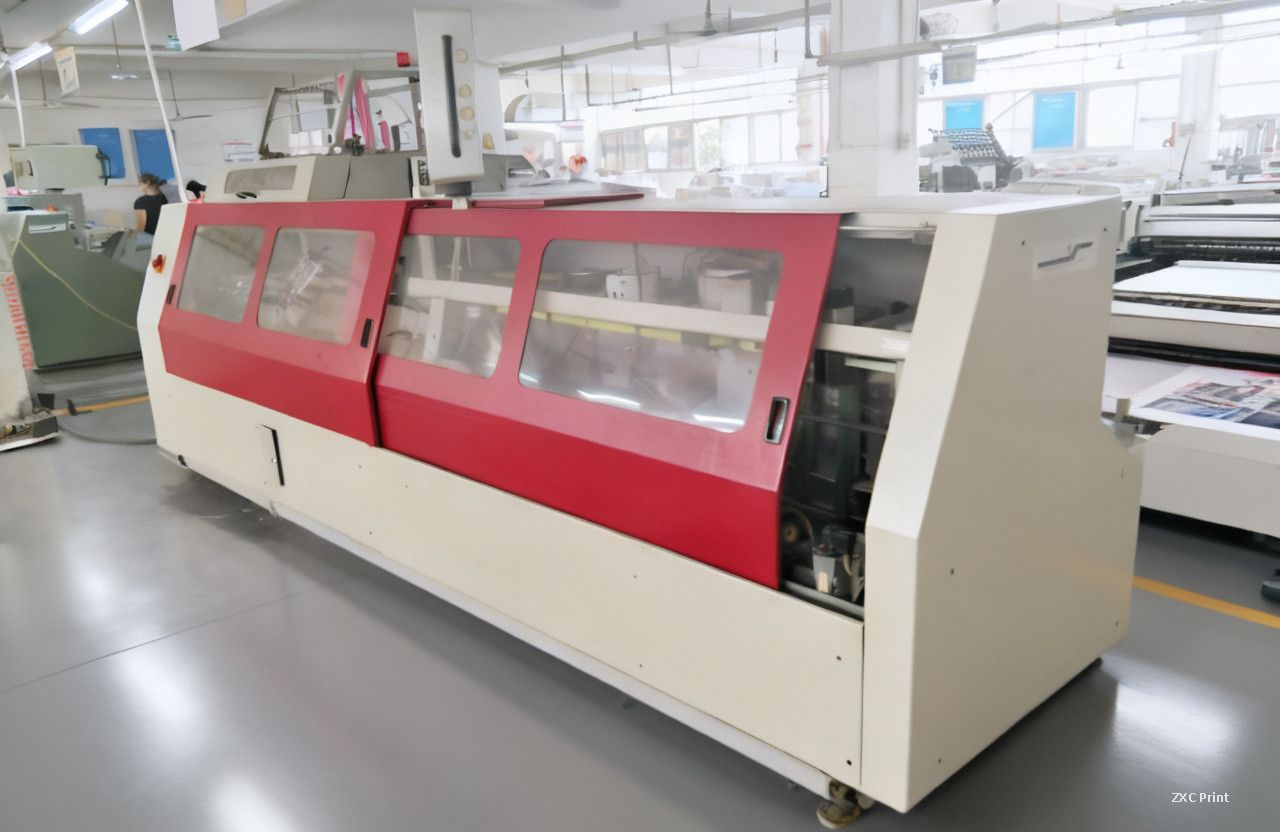
An adhesive perfect binding line is built from modules, so the buyer can combine the stations that the work actually needs. A full configuration runs through gathering, endpaper tipping, jogging, clamping the book block, spine milling, notching, gluing, applying gauze or card, a second glue pass, cover feeding, cover wrapping, spine scraping, spine heat setting, spine forming, splitting doubled blocks, three knife trimming, stacking and counting, and final delivery. Any of these steps can be left out of a shorter line.
Installation and use are flexible. Signatures can be fed by hand, or a powered lifting clamp can place a stack of signatures accurately on the feeder table. Between them, the stations complete the whole binding cycle for a paperback book, from loose folded sheets to a trimmed, counted product leaving the delivery end.
Welded binding, a third route
Welded binding was developed in the United States in the 1980s. The paper is treated with a hot melt resin during papermaking, so the raw material carries the adhesive function inside itself. At the binding station the edge of the block is heated by a high energy source, such as direct heat, infrared high frequency waves or ultrasound. The resin melts and the sheets weld together.
No glue, thread or wire is needed. The bond is strong and the finished book lies flat when it is opened, which suits reference work and manuals. The method has not been widely adopted, largely because it depends on a special paper supply rather than on equipment the bindery can add to an existing line.
What the choice means for a print buyer
The form of the line decides what the finished book can be. Wire side stitching suits thin books and booklets where the spine does not need to carry a printed title. Adhesive perfect binding covers the widest range of paperbacks, from novels to manuals, and the modular design means a printer can match the station list to the run. Welded binding remains a specialist option, chosen when flat opening matters more than a conventional spine.
For anyone ordering printed books, the practical question is less about the machinery and more about the product. Page count, paper weight, spine width and how the book will be used all point to one binding method, and that method decides which line produces the job. A printer who runs all three families can take a project from one form of line to another without sending the work outside.