
Anilox Rolls Explained: How They Control Flexographic Print Quality
When you order flexographic printing for labels, flexible packaging, or corrugated cartons, color consistency is usually the first thing you check — and the last thing you want to see drift between runs. One of the least visible but most influential components behind that consistency is the anilox roll, a precision-engraved cylinder inside the flexo press that meters the exact amount of ink delivered to the plate.
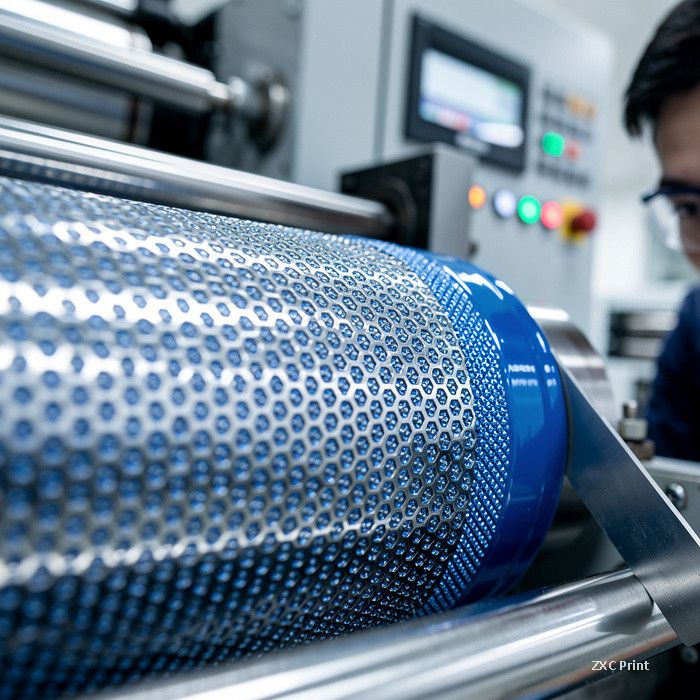
Unlike the long inking trains of offset presses — which can use twenty or more rollers to distribute ink — a flexo press uses a short inking system. The anilox roll sits at the heart of it: its surface is covered with thousands of tiny cells that pick up ink and release a precise, uniform film onto the printing plate. If the roll is well matched to the job and properly maintained, color stays stable from the first sheet to the last. If it is not, you may see banding, mottled solids, moire patterns, or a gradual fade in color as the run progresses.
What to Know About Anilox Roll Construction
Two main types of anilox rolls are used today. Metal rolls are machined from seamless steel tube, copper-plated, engraved, and finished with a chrome layer for wear resistance. Ceramic rolls are coated with a plasma-applied ceramic layer and then laser-engraved. Ceramic rolls are more durable and can carry much finer cell counts — up to 1200 lines per inch (lpi) — which makes them the standard for high-quality process-color work. Finer cells hold less ink, so they produce a thinner, more even film that dries faster and controls dot gain at high press speeds.
The cell line count is the single most useful specification for a buyer to understand. It tells you how much ink the roll will lay down: a low line count (e.g., 200–400 lpi) means large cells and heavy ink coverage, ideal for solid areas on rough, absorbent substrates like kraft corrugated board; a high line count (e.g., 800–1200 lpi) means small cells and light coverage, ideal for fine screens, vignettes, and small text on smooth, non-absorbent films.
Cell Shape, Angle, and Why Moire Happens
Cell geometry also matters. Common shapes include pyramid, truncated pyramid, hexagonal, and trapezoidal cells with a 45-degree spiral angle. Truncated-pyramid and hexagonal cells release ink more completely and clean more easily, which is why they pair well with doctor blade systems; pyramid cells are simpler and work with rubber ink fountain roller systems but hold ink less cleanly.
The angle of the cells — typically 30, 45, or 60 degrees — interacts with the halftone screen angles of the plate. When the two angles clash, a moire pattern appears as an unwanted wavy grid across the image. Professional flexo shops match the roll cell angle and line count against the plate screen ruling, typically specifying an anilox line count three to four times the plate screen ruling to keep the interaction predictable.
Maintenance: What Wear Looks Like from the Outside
Anilox rolls wear, and the symptoms show up in your printed pieces before they show up in a maintenance log. A worn roll holds less ink, so solids start to look patchy and screens lose density. Dried ink left in the cells — common with UV inks — reduces cell volume and has the same effect. Good shops clean rolls regularly with appropriate solutions, use ultrasonic cleaning cautiously (it can damage ceramic surfaces if overused), and check that doctor blades run parallel to the roll with minimal pressure to avoid scoring the surface.
Questions to Ask Your Flexo Printer
If color consistency matters for your project — and it always does — these questions help you gauge whether the press-side setup is under control:
• Is the anilox roll line count matched to the plate screen ruling for this job?
• Is the roll checked for wear before a critical repeat order?
• What cleaning routine is in place for UV or metallic inks?
• How is pressure between the anilox roll and plate cylinder set and verified?
None of this requires you to become a press engineer. The practical takeaway is simple: consistent flexo color is not luck. It is the result of a properly specified, properly matched, and properly maintained anilox roll. When you evaluate a flexo supplier, asking how they manage this component tells you a great deal about how consistently your packaging will look — run after run.